Anyone who wants their pool water to be warmer almost always turns to a heat pump first. That’s an obvious choice — but it’s only half the story. After all, a heating system simply replaces heat that has previously been lost. So the question isn’t just ‘How do I generate heat?’, but first and foremost: ‘Where am I losing it?’
We are manufacturers of pool covers and do not sell heat pumps. That is precisely why we can carry out this comparison without any vested interest in heating technology — resulting in a clear conclusion that may come as a surprise to many.
Where the heat is actually lost
A swimming pool loses heat in four ways:
By far the largest factor is evaporation. This represents a significant amount of energy: when water evaporates, it carries away heat of evaporation — considerably more energy than one might expect. Every litre that escapes as vapour removes heat from the pool that had previously been added to it.
It’s the same principle as a lid on a saucepan: when the lid is off, the saucepan cools down constantly, and the hob has to work harder to counteract this. With the lid on, the heat and water stay inside the saucepan.
An outdoor swimming pool without a cover is like an open pot — 24 hours a day, even at night when nobody is swimming.
Two fundamentally different approaches
| heat pump | pool cover | |
|---|---|---|
| Principle | replaces lost heat | prevents loss |
| Running costs | Power consumption during each operation | none |
| Works at night | only when it’s running | yes, permanently |
| Works in windy conditions | needs to turn up the heat | Yes, it shields the water from the wind |
| Water consumption | remains high | decreases because less evaporates |
| Chemical consumption | unchanged | decreases, less evaporation and UV radiation |
| Safety | none | improves safety and helps prevent accidents |
| Purchase | a smaller investment | greater investment |
| Maintenance | Filters, refrigerants, wear parts | Cleaning; replacement of individual slats where necessary |
The key difference lies in the second line: a heat pump costs money for every hour it runs. A cover costs money only once and then operates for free.
What the version with solar slats offers in addition
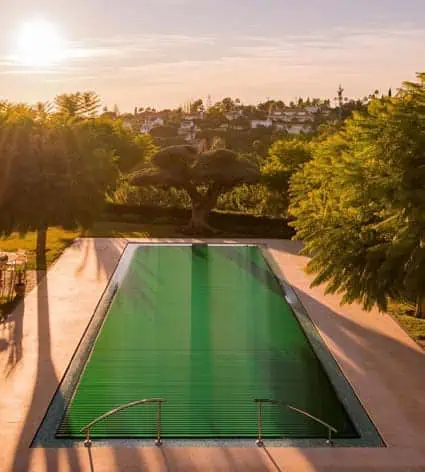
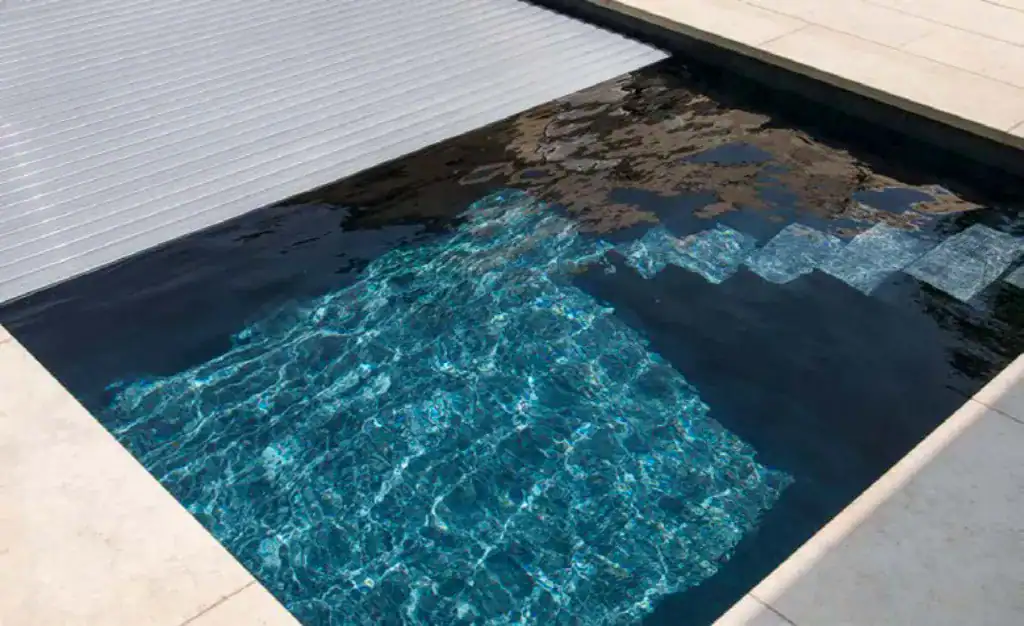
A cover does not just have to provide passive insulation. In the case of solar slats (light-transmitting cover slats), the top side is transparent or semi-transparent, whilst the underside is black. Sunlight passes through the slat; the dark underside converts it into heat and transfers it to the pool water.
So the cover doesn’t just retain heat — it generates extra heat, without electricity, without any equipment and without any maintenance.
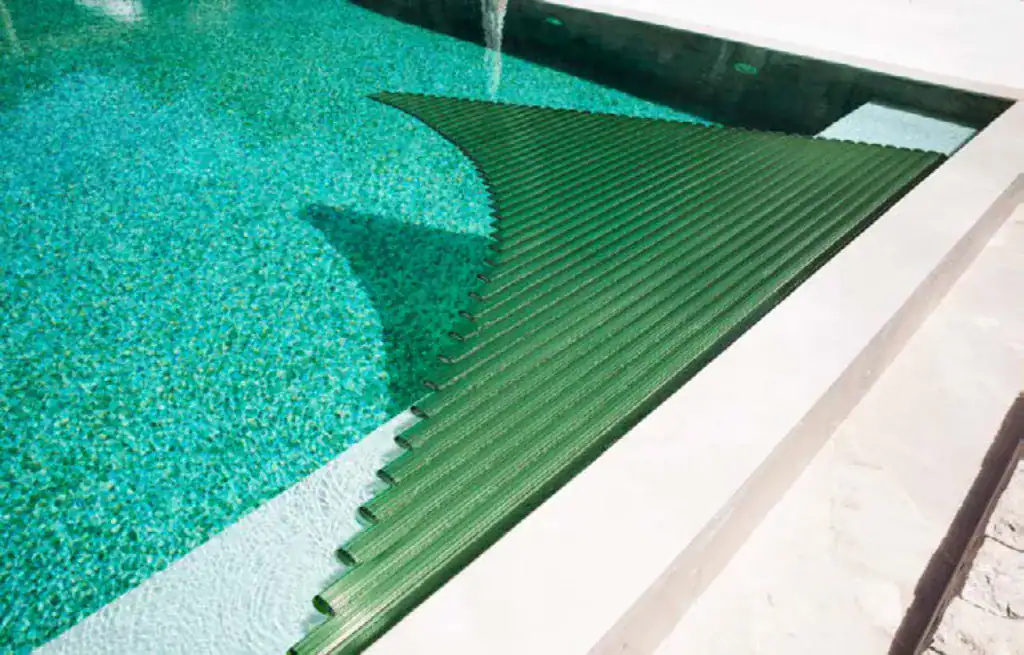
Transparent top, black underside, with several hollow chambers in between. Whenever the sun shines, the cover generates heat in the pool water — whilst minimising evaporation at the same time.
The extent of this effect depends on the location, orientation, time of year, pool size and desired temperature. That is why we deliberately do not give a standard figure in degrees: any such figure would be a model value — and would not apply to your pool. To provide a reliable estimate, we’ll carry out a calculation for your pool — our savings potential calculator provides an initial indication.
The honest answer: It’s not a case of one or the other
If you only install a heat pump, it’s like trying to heat an uncovered swimming pool. The system runs for longer, uses more electricity and needs to be larger in capacity.
If you simply cover the pool, you retain the existing heat in the water and gain additional heat from solar slats (light-transmitting cover slats) — but you cannot raise the temperature at the touch of a button, for example before visitors arrive at the weekend or during a rainy summer.
The most economically sensible order is therefore:
Anyone who buys the heat pump first and fits the cover later will usually have chosen a heat pump that is too large for their needs.
What this means for the design specifications
Discuss the sequence of works with your swimming pool contractor before ordering the equipment. A pool with a closed cover has different heating requirements to an open one — if the heat pump is sized for an open pool, you’ll end up paying twice: once for a system that’s too large, and then for every hour of operation in partial-load mode.
Frequently Asked Questions
Does a pool cover replace the heat pump?
No — and we’re not claiming that either. It significantly reduces heating requirements and, in the version with solar slats, also provides additional heating. However, if you want to maintain a certain temperature regardless of the weather, you’ll also need a heat pump. Just a smaller one.
Which is more effective — a more powerful heat pump or a cover?
In the case of an uncovered pool, a cover offers greater structural benefits because it seals off the main source of heat loss rather than working against it. A more powerful heat pump primarily increases electricity consumption.
Is a cover worth it even for an indoor pool?
Yes, for one further reason: indoors, the evaporated moisture condenses on the walls and ceiling. The dehumidifier then has to remove this moisture from the air again — which consumes more energy. A cover reduces the load on both systems at the same time.
Can I combine the two?
That’s the rule, not the exception. The pool cover reduces the heating requirement, whilst the heat pump covers the rest — and runs for a much shorter time as a result.