On paper, both supposedly do the same thing: they keep the heat in the pool, keep dirt out and extend the swimming season. In practice, however, they solve two different problems.
We manufacture swimming pool covers and do not sell pool enclosures. This makes this comparison easier: we have no vested interest in persuading you to choose one solution over the other.
Reading time: 8 minutes Manufacturer since 1983, Bad Tölz As of July 2026
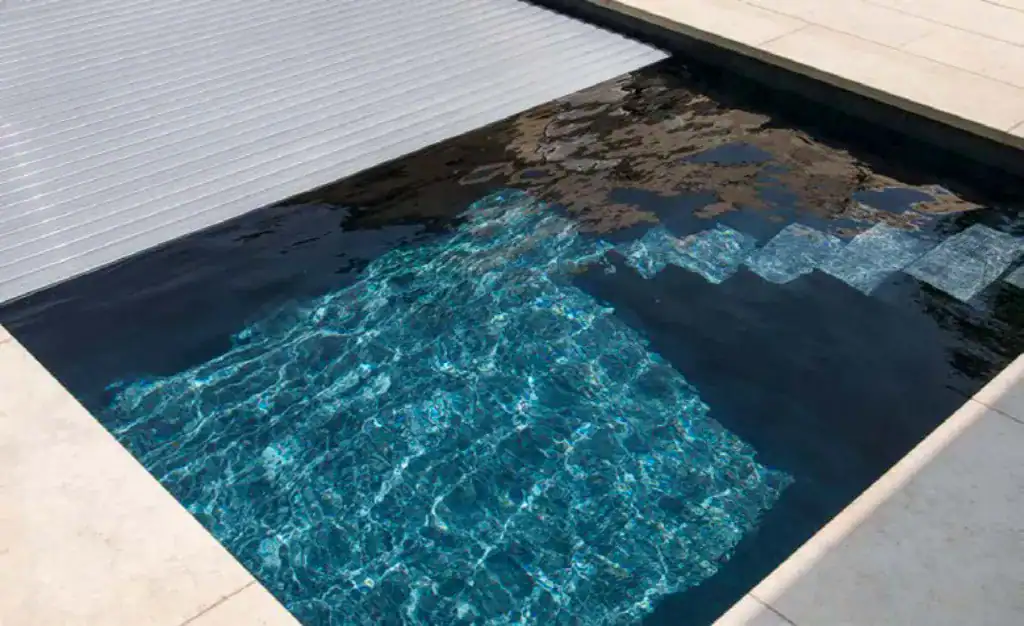
The cover lies on the water. It seals off the water surface — where practically all the heat is lost. When closed, it is barely visible; when open, it disappears into the pit or onto the roller unit at the pool edge (above-ground system).
The poolenclosure stands above the pool. It encloses an airspace and also protects the area around it. It is a visible structure, usually slid to one side in summer — and it needs that space too.
pool cover
Operates on the water’s surface. When closed, it lies on the water; when open, it retracts into the pit.
pool enclosure
Covers the pool. It encloses the airspace above the water and makes the pool usable in all weathers. However, it requires a lot of space to be moved and is always visible.
Schematic cross-sections, not to scale in relation to one another. ROLLO SOLAR does not manufacture pool enclosures — the enclosure section is therefore shown as a drawing.
The cover solves the water problem. The pool enclosure solves the weather problem.
Which of the two is right for you depends less on your budget than on which of the two problems you actually have.
02
A ten-point comparison
pool cover
pool enclosure
Heat loss from the water surface
directly prevented
Indirectly via the airspace
evaporation
directly prevented
reduced, not prevented
Swimming in the rain and wind
no
yes
Appearance in the garden
Virtually invisible
defines the garden
Space required next to it
None
No sliding movement required
Planning permission
Not usually required
Possible depending on height and local authority
accident protection
Provided by a continuous support edge
via lockable elements
Operation
Automatic
sliding, in some cases involving several segments
Maintenance
Generally maintenance-free
Rails, rollers, seals, cleaning
Price
from approx. €10,000
Market prices from approx. €5,000 to over €14,000
Two lines are worth a second look.
evaporation
This is the single biggest contributor to heat loss — the same principle as putting a lid on a saucepan. The cover addresses this issue directly. The pool enclosure also reduces evaporation because the air underneath becomes more humid and reaches saturation, but it does not prevent it entirely. It is a roof, not a lid.
Maintenance
This is rarely factored in. A pool enclosure has running rails, rollers and seals exposed to the elements — these get dirty, wear out, need cleaning and, for example, need to be lubricated with silicone oil. The cover is generally maintenance-free; every now and then, profiles need to be replaced — with us, this is done individually using clips.
03
The three construction heights: low, medium, high
Anyone comparing pool enclosures will immediately come across three categories. They differ not only in price, but also in what you can do with them afterwards.
All four designs are shown to the same scale, with the same pool size. The difference in size is the key factor.
Low-profile pool enclosure
Just above the water’s surface, often only 50 to 90 cm high. It provides protection and insulation, but you cannot stand underneath it — it is opened up for swimming. Visually, this is the most understated option and the most affordable. It is the closest to a pool cover, without offering the same advantage at the water’s surface.
Medium-height pool enclosure
Around 1.20 to 1.80 m. A compromise: you can bend down to enter and swim in it in bad weather, but you cannot stand upright inside it. In practice, this is the most common choice.
High pool enclosure
From around 2 m, effectively a conservatory above the pool. Year-round use, maximum comfort — and the most conspicuous structure. Almost always subject to planning permission.
Rule of thumb: the higher it is, the more you’ll use it — and the more it will stand out in the garden. Anyone considering the low-profile option should honestly assess whether a cover might achieve the same goal more discreetly.
04
With or without rails?
The classic pool enclosure runs on side floor rails. This is stable and tried-and-tested, but means two visible profiles in the patio surface, in which leaves and dirt can accumulate.
The rail-free pool enclosure — also known as a ‘pool enclosure without rails’ — does away with the continuous floor rail; the segments run on rollers or on individual guides recessed into the decking. This looks much tidier and is more practical, particularly when it comes to cleaning and maintenance.
With a rail
Stable and tried-and-tested. Two visible profiles in the decking where leaves and dirt can accumulate.
Rail-free
Visually less obtrusive, easier to clean. However, it usually requires locking points to secure it against storms and strong winds.
What you should check and what’s important:
01
How are the segments secured against wind and storms?
02
How snow-resistant is the pool enclosure, and is the structure designed to cope with this? Is there written confirmation of this?
03
How much maintenance and upkeep is required — how often do the guide rails need to be cleaned, and can the rollers still be replaced individually after several years?
By way of comparison: with a recessed cover, this question does not arise — there are no visible rails. We have set out which installation option is best suited to your pool in a separate guide.
05
Polycarbonate or glass?
Most pool enclosures are made from polycarbonate sheets: lightweight, shatterproof, good at insulating, and significantly cheaper. The downside is ageing — without effective UV protection, the sheets yellow over the years and become dull.
Glass looks more upmarket, remains clear indefinitely and is easier to re
Glass. However, it is heavier, more expensive, not shatterproof and places greater demands on the structural design. In practice, glass is mainly used in tall designs where a conservatory-style look is desired.
If you opt for polycarbonate, ask about the material thickness and UV-protective coating — just as you would with a cover. Our profiles feature a wall thickness of up to 1.45 mm and a TriEX UV-protective coating as standard. If a supplier can specify these, that’s a good sign.
Up to 1.45 mm wall thickness, TriEX UV-protective coating — as standard on our polycarbonate profiles.
06
How much does a pool enclosure cost?
Market prices start at around €5,000 for flat, basic designs. High-quality versions often cost €14,000 and above.
Anyone looking for an affordable pool enclosure should ask the same six questions when considering any quote:
1
What pool size does the price refer to?
2
Are the foundations and installation included, or are they to be provided by the customer?
3
What snow load and wind load classes are guaranteed — in writing?
4
How thick is the material, and is there an additional UV-protective coating — not just ‘UV-stabilised’?
5
Will spareparts and the manufacturer still be available in the future?
6
Who is your point of contact in the event of a warranty claim — and in which language?
Incidentally, the same questions apply to covers. We’ve set out in detail how to compare quotes reliably in our article on costs.
07
Where the pool enclosures are manufactured
A large proportion of the pool enclosures sold in Germany are manufactured in other European countries, often in Poland or the Czech Republic. There are many experienced manufacturers based there offering attractive prices.
What matters is not where they are manufactured, but what is guaranteed in writing:
Certificates of compliance
Are there test certificates for snow and wind loads, in German or English?
Spare parts
How long will rollers, seals and panels be available?
Contact
Who will come out in the event of a fault, and how quickly?
Speed
How quickly will you receive your system — and, if necessary, spare parts?
Warranty
What exactly does it cover, for how long, and where would it need to be enforced in the event of a claim?
If a supplier answers these five points clearly and in writing, the country of manufacture is not particularly important. If they evade the questions, the price advantage would be too costly for us.
As for our products: we have been manufacturing in Bad Tölz since 1983, with our own metalworking shop, motors developed in-house and our own control systems. Not because that’s automatically better — but because we can answer each of these five questions ourselves with a clear conscience.
08
When a pool enclosure is the right choice
Three situations in which we would advise you to opt for a pool enclosure.
You want to swim whatever the weather.
Wind, drizzle, a cool evening: under a medium-height or high pool enclosure, you can carry on swimming. A cover doesn’t do that — it lifts up, and you’re left at the mercy of the weather.
You want to extend the swimming season as much as possible.
The pool enclosure also warms the air above the water. During the transitional months leading into autumn and winter, this makes a noticeable difference — more so than a cover alone can achieve.
The pool is very exposed.
Under trees, on a slope, in a windy spot: wherever leaves, pine needles and dust are regularly blown in, the pool enclosure keeps the whole area clean, not just the water’s surface.
If any of these points apply to you, speak to a specialist company — for example, via the search function on the website of the German Swimming Pool & Wellness Association — and, if necessary, combine a pool cover with a pool enclosure.
09
When a cover is the right choice
You want your garden to remain a garden.
The most common reason we hear is that a pool enclosure is too bulky for us. A recessed cover disappears completely — when closed, you see a uniform surface; when open, you see nothing at all.
Not enough space available.
Pool enclosures are slid to one side, and the tracks must remain clear at all times. On a terrace, on a narrow plot or right up against the house wall, this space is often simply not available.
Planning permission shouldn’t be an issue.
Depending on the height and the local authority, a pool enclosure may require planning permission. A cover generally does not.
Safety is the top priority.
A slatted cover with a surrounding support edge can bear a total load of 100 kg. If a child or an animal falls onto the closed surface, they will not sink in immediately. What load capacity really means — and where its limits lie — is explained in the safety article. Neither solution replaces the duty of supervision.
Maintenance and cleaning should be kept to a minimum.
No guide rails that need cleaning or lubricating. No rollers or cable pulls that need replacing. The cover is generally maintenance-free, and profiles can be replaced quickly and easily.
You value ease of use.
Press a button on your remote control, and the cover opens. No strenuous pushing, no manual locking.
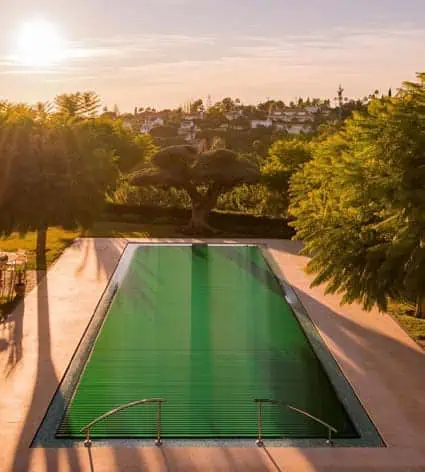
A closed slatted cover in the evening light — the water surface is covered, whilst the garden remains open.
10
And what about the solar effect?
This is a difference that is rarely explained.
Pool covers
A solar slatted cover is translucent on top and coloured black on the underside. Sunlight passes through the slats, hits the dark underside, and the heat is transferred directly to the water. At the same time, the closed surface prevents this heat from evaporating again overnight.
pool enclosure
With a pool enclosure, the solar energy initially enters the air space, not the water. From there, some of the thermal radiation is transferred to the water — the larger the air space, the less heat is transferred.
We deliberately do not quote fixed figures here — every pool location is different, every usage scenario is different, and any blanket figure would be a theoretical value. Instead, we calculate your savings on an individual basis. The Energy Check gives you an initial rough overview.
Yes. In the upmarket private sector, we regularly see pools with both a pool enclosure and a cover: the pool enclosure to protect against the elements, the cover to save energy.
This makes perfect technical sense, as both address different challenges. It’s important that both are planned for at an early stage. Tip: If you’re still undecided — have the pre-installation fitted, then you can easily retrofit your pool cover later.
We’d be happy to advise you on pre-fitting a pool cover or helping you find the right swimming pool builder.
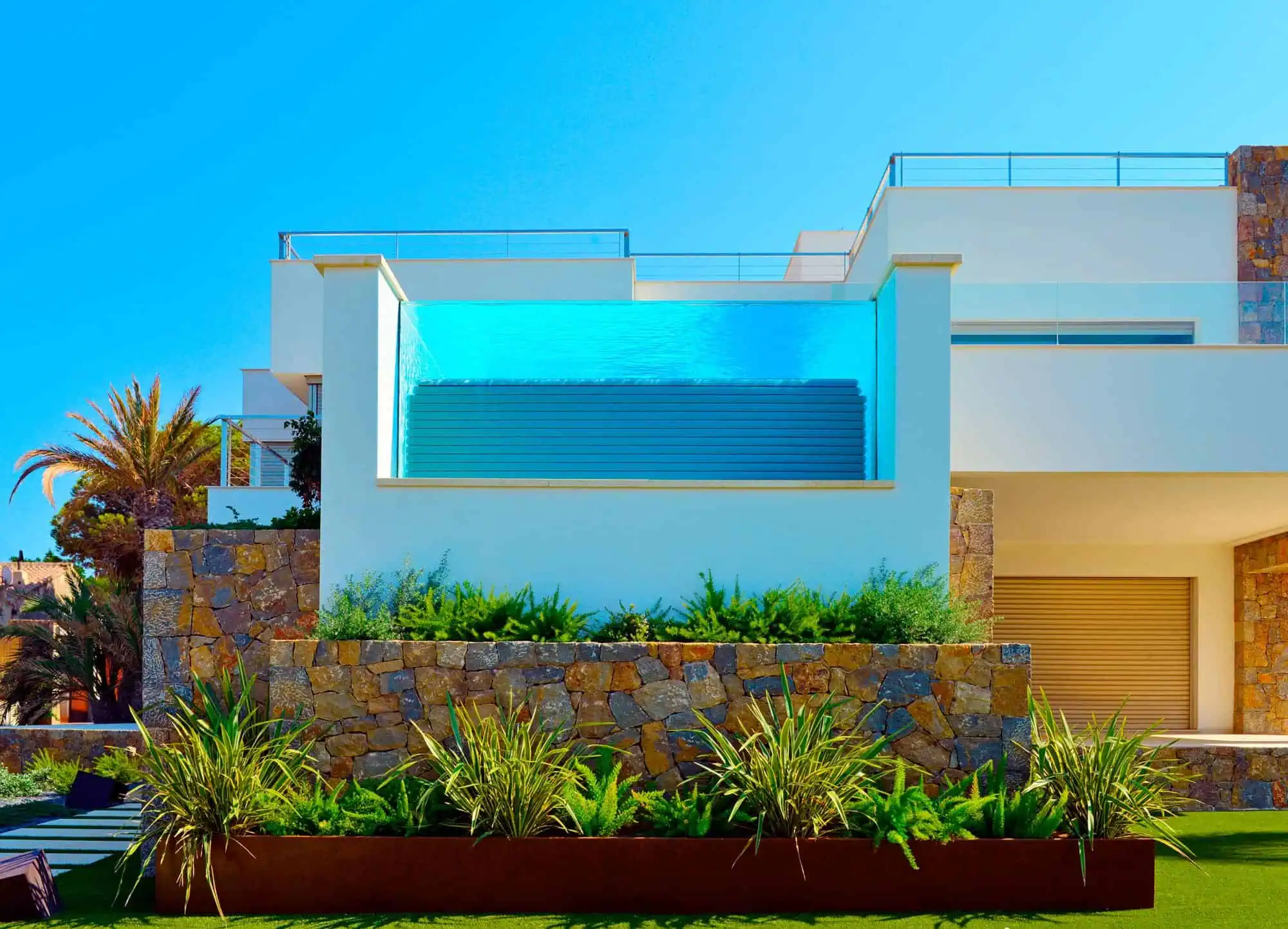
Here you can see an in-ground system: in this case, the roller unit is located inside the pool.
12
Frequently Asked Questions
Does a pool enclosure replace the cover?+
No. It mainly protects against the elements, not the water surface itself. However, the greatest heat loss occurs through evaporation at the surface — this is where the cover comes into its own.
Does a pool enclosure require planning permission?+
That depends on the height, the federal state and the local authority. Low-profile designs often do not require planning permission, whilst taller ones may. Ask
It is best to ask your specialist retailer.
Which is cheaper, a pool enclosure or a cover?+
The starting prices for pool enclosures are usually slightly lower than for covers, but depend heavily on the construction height: low-profile pool enclosures start at around €5,000, whilst tall ones can easily exceed €14,000. Our covers start at around €10,000; each system is made to measure. Your specialist dealer will be able to give you a firm price.
What does ‘rail-free pool enclosure’ mean?+
It means there is no continuous floor rail running along the floor. This is more visually appealing and eliminates an additional tripping hazard.
We already have a pool enclosure — is it worth getting a cover as well?+
In most cases, it’s a good investment because evaporation continues to take place under the pool enclosure: the water’s surface remains exposed, so heat and moisture are lost to the air. Only the cover seals off the surface and stops this loss.
Do you also build pool enclosures?+
No. We manufacture swimming pool covers exclusively, and have been doing so in Bad Tölz since 1983. If you need a pool enclosure, it’s best to check with BSW, ÖVS or Aqua Suisse.