
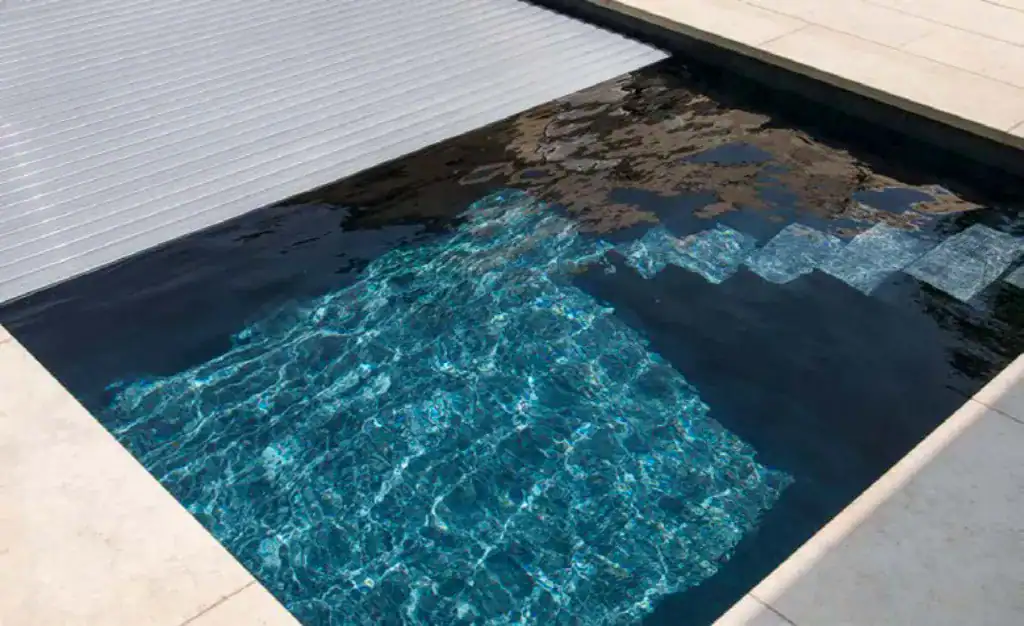
Which pool cover is right for your pool?
From a simple tarpaulin to an automatic slatted cover: a comparison of all six types — heat, safety, comfort and cost.
A cover offers more benefits than most people realise.
Most people think first of cleanliness — no leaves, no insects, no sand in the pool. That’s true, but it’s the smallest benefit. The biggest benefit lies elsewhere:
“By far the greatest energy loss in a swimming pool is caused by evaporation from the water’s surface.”
A cover has several benefits
Heat stays in the pool. Less evaporation means less reheating — and a longer swimming season.
Lower water consumption. Water lost through evaporation needs to be topped up.
Less chemical use. Less UV light in the pool, less algae, less disinfectant.
Less cleaning required. What doesn’t fall in doesn’t need to be filtered out.
Greater safety — depending on the design. Promises are often exaggerated here: Section 06 sets the record straight.
How much does this actually save?
There’s no reliable way to give a blanket answer — the effect depends on the pool’s size, location, wind conditions and usage. Anyone who quotes you a fixed percentage is basing their calculations on a model, not on your pool. Calculate the potential savings for your pool →
Six ways to cover a pool.
Each design type serves a different purpose. The cards show the extent of heat retention, safety and comfort — click to view the details.
Cover / Winter cover
Lay it over, secure it, overwinter — the basic solution.
Solar film
Floating air pockets that capture the sun’s heat.
Safety cover
A tightly stretched net or tarpaulin — supports a child.
Louvre cover
Operates at the touch of a button — provides warmth and security, every day.
Pool enclosure
A sliding roof covering the entire pool.
Lifting floor
The floor rises — the bath disappears.
The cost categories € to €€€€ are used to classify the different types relative to one another and do not represent actual prices — specific figures are given in section 07.
Every type has its pros and cons.
Covering tarpaulin / winter tarpaulin
The simplest solution.
A tarpaulin that is laid on or over the pool and secured with eyelets, tension ropes or water bags. It keeps leaves and dirt out and protects the pool over the winter.
Suitable for: above-ground pools, small pools, winter storage only.
Solar cover
Heat from solar energy — but with its pitfalls.
A floating sheet, usually with air chambers, which rests directly on the water. The air chambers allow sunlight to reach the water, whilst at the same time the sheet reduces evaporation.
Suitable for: Price-conscious pool owners — without children or pets.
A solar cover is not a safety cover — in fact, it increases the risk. Anyone who falls in will become trapped under the cover and will be unable to find the edge. Solar covers must never be placed on a pool to which children or animals have unsupervised access.
Safety cover
Safety first.
A tautly stretched net or a sturdy tarpaulin, anchored around the pool and capable of supporting the weight of a child or animal. In France, such systems are regulated by standard NF P 90-308.
Suitable for: Households where safety takes precedence over comfort.
Slatted cover (roller shutter cover)
The only design that combines heat, safety and comfort.
It consists of many individual hollow-chamber profiles, connected via joints to form a continuous surface that is rolled up and down onto a shaft. It is electrically operated — the pool opens and closes at the touch of a button. This eliminates the key drawback of all manual systems: a cover that is easy to operate is actually used. And only a closed cover saves energy.
Ideal for: Permanently installed pools that are used regularly.
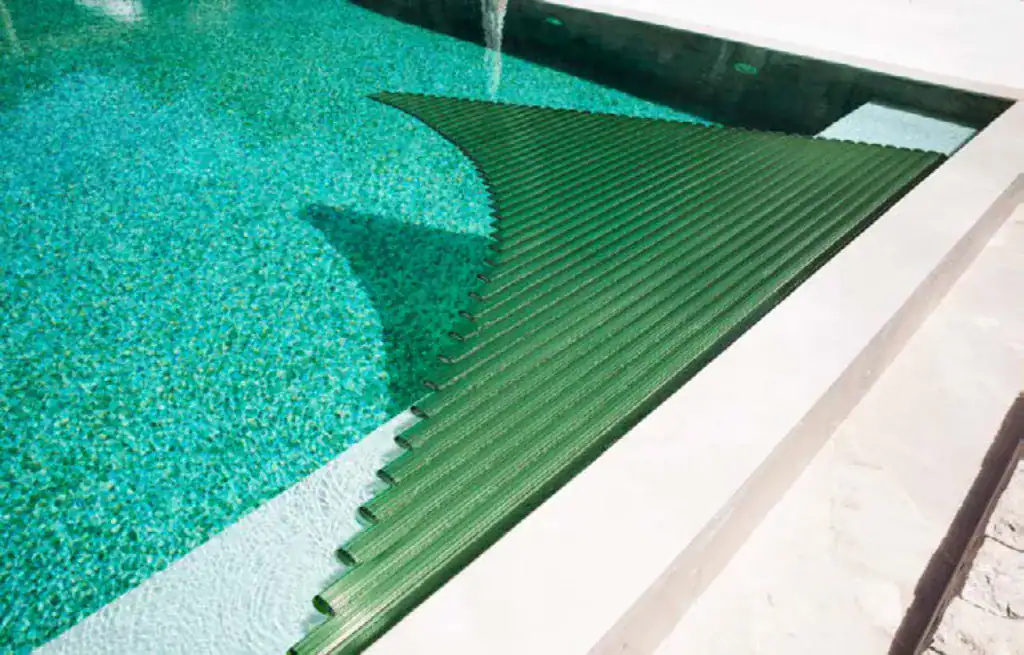
The shaft is visible on the pool edge, clad in wood, stainless steel or plastic. Can be retrofitted to almost any existing pool. More about above-ground →
The shaft is concealed in a shaft beneath the pool coping — when the cover is open, none of the mechanical components are visible. The more elegant solution for new builds and refurbishments. More about in-ground →
Transparent top surface, black underside: sunlight passes through the profile, is converted into heat at the bottom and transferred to the pool water. The cover not only retains heat — it actively heats the water.
Pool enclosure
Strictly speaking, not a cover, but a roof.
A sliding structure made of profiles and polycarbonate panels covering the entire pool — either low-profile or high-profile.
Ideal for: Anyone who wants to swim all year round – even when it’s raining.
Enclosure or cover? The detailed comparison →
Retractable floor
The pool disappears completely.
The pool floor itself is raised and lowered. Above it is a walkable surface that blends seamlessly into the terrace — the pool disappears completely.
Ideal for: New builds with the highest design standards.
Further reading: Lifting systems and lift floors in detail →
Which one is right for you?
Two pieces of information are enough to get you started.
This is no substitute for professional advice — every pool is different. For a reliable recommendation: use the configurator.
Polycarbonate or PVC?
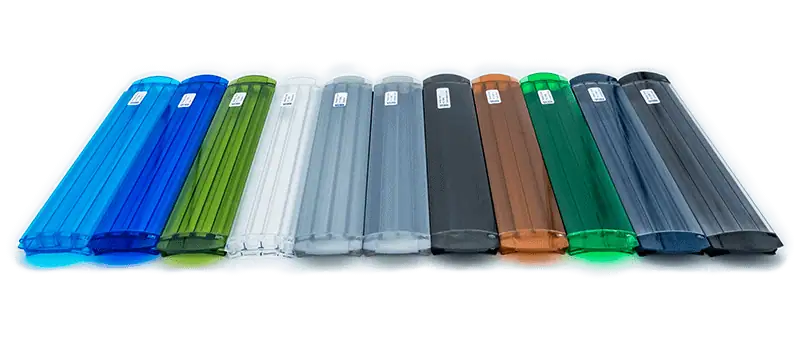
With slatted covers, the profile material determines the appearance, thermal properties and service life.
The rule of thumb
Where high thermal stress is to be expected — full south-facing position, dark pool base, solar operation — polycarbonate is the safe choice. PVC is the robust, opaque alternative when solar efficiency is not a priority. Both materials are resistant to salt and rot. View the full profile comparison →
What ‘walkable’ really means.
Hardly any other term is used so imprecisely when it comes to pool covers. So here’s the honest breakdown.
Design Cover PC and PVC are designed to support 100 kg in total, whilst Mini Cover is rated at 80 kg. If a child or animal falls onto the closed cover, they will not sink in immediately.
However: Increased accident protection is only achieved if the cover rests all the way round on a support edge or a handrail. If this support is missing, the surface can give way at the sides — in which case the load-bearing capacity of the individual profile is insufficient.
In the case of overflow channels, there is no protection against accidents without a lowered water level and a handrail. Additional straps and carabiners can be fitted retrospectively.
And in any case, the following applies: no cover in the world can replace the duty to supervise children near water. It is an additional barrier — not a licence to look away.
Quality can be recognised by independent testing:
Currently undergoing a re-audit; once the audit has been completed, the updated entry will be made in the hail registers.
The French safety standard, tested in accordance with LNE, for selected products.
Full details of all certifications: Certifications and test reports →
How much does a pool cover cost?
An honest answer reveals two very different worlds: off-the-shelf products with fixed prices — and bespoke solutions, where every pool is different.
Tarpaulins and films
Fixed list prices, available immediately, for standard pool sizes from stock.
Slats, roofing, adjustable floor
No list price — every pool is different. The price is based on dimensions, materials and installation.
Made to measure, installed and with training provided. What to factor in: long-term savings on heating energy, less water, fewer chemicals, less cleaning — over the entire service life. For commercial swimming pools, this often pays for itself through reduced running costs sooner than expected.
Factors determining the specific price
Quick answers.
More detailed information — with over 30 questions on technology, safety, delivery times and price — can be found in our FAQs.
All questions and answers →Yes. An above-ground roller mechanism can be fitted to almost any existing pool without the need for structural alterations. Only the in-ground version requires a shaft and is therefore usually planned for new builds or refurbishments.
Yes, a slatted cover is winter-proof and protects the pool even during the colder months. Proper preparation and a lowered water level are essential — see the winter care guide.
That depends on the material, water maintenance and usage. Rollo Solar offers a 5-year guarantee on Design Cover PC, 3 years on Design Cover PVC and 2 years on Mini Cover — the actual service life is significantly longer with proper care. Individual slats can be replaced using clips, without having to replace the entire cover.
Automatic systems do. Rollo Solar uses 24-volt DC drives — this significantly increases safety in wet areas compared to mains voltage.
A cover lies on or just above the water surface; an enclosure is a roof over the entire pool. Which of the two suits your pool is what we clarify in the detailed comparison.
Solar films and solar-powered slatted covers. Both allow sunlight to reach the water whilst reducing evaporation. The difference lies in practical use: the film must be removed and replaced by hand each time, whereas the slatted cover operates at the touch of a button.
An honest comparison from the manufacturer of slatted covers. →
All the factors affecting price — and what to take into account. →
Recessed, deck mounted, pit — what’s possible and when. →
What load capacity really means — and where it ends. →
Over 30 answers on technology, safety, delivery times and costs. →
Step-by-step guide to winter preparation. →
All technical specifications side by side. →

And what about your pool?
Every swimming pool has different dimensions, a different location and different requirements. We’ll work it out for you — with no obligation.